Join a small, welcoming, and supportive community of writers for a personalized writing retreat at one of West Virginia’s award winning and charming historic B and B’s.
Writers of all experience levels and projects are welcome. A perfect opportunity for those who have been wanting to dive into that book project, collection, essay, family history, or script.
Retreat is led by the award winning writer, Dr. Michelle LaFrance. Michelle has taught writing, coached writers, and facilitated writing communities for over 25 years.
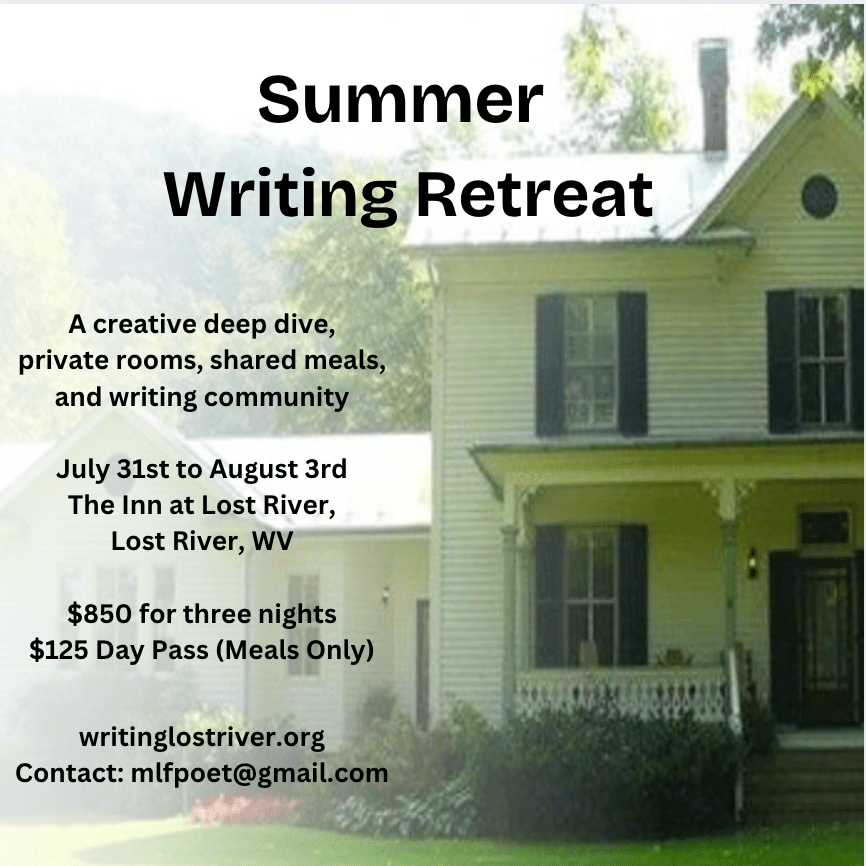
Registration for the full weekend pass includes a private room, breakfast, lunch, and family-style dinner, a Saturday evening public reading of your work, and optional hiking or swimming in George Washington National Forest
For those with alternative lodging, day passes are available. This pass includes lunch, dinner, the Saturday evening reading, and other community connections.
Rates: Full weekend rate $850.00 Day Pass: $125.00
I ask all writers to set a writing goal for themselves for their time at the retreat.
It is important to keep our goals simple and realistic, of course. This helps us to avoid burning ourselves out or feeling like we’ve failed to use time effectively.
This goal should be doable within the window of time the retreat offers. In most cases, less is more. Many people will come to a retreat or a month-long class with the idea that they will write a few articles or a full novel; this is far more than we can accomplish in our time together at a retreat. In my experience, even the most productive writers rarely write more than 7 pages (about 3000 words) a day, even when at a retreat.
What type of goal or benchmark would be most helpful for your ongoing work on the project?
For a three or four day retreat, an effective goal might be to complete a “zero” or very rough draft of an essay, chapter, report, or article. A writer might also choose something more useful to the process of a larger project (an outline, initial research reading and note taking completed, etc.).
For those working on longer projects (like books or scripts), I recommend thinking about a “chunk” of that project for the goal. A skeleton draft (with areas that are fleshed out and areas that can be filled in later) can also be effective.
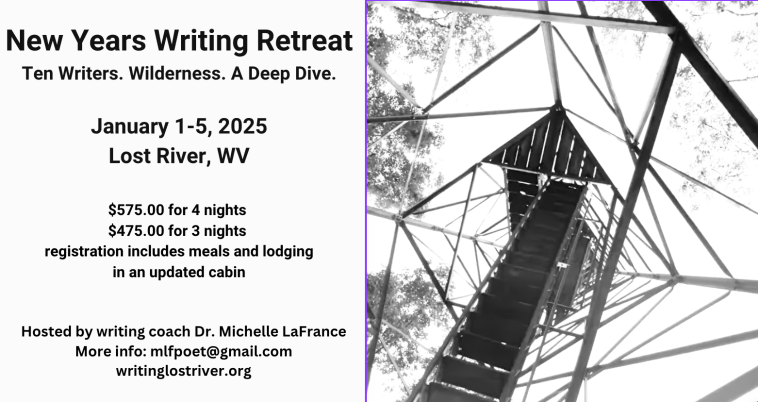
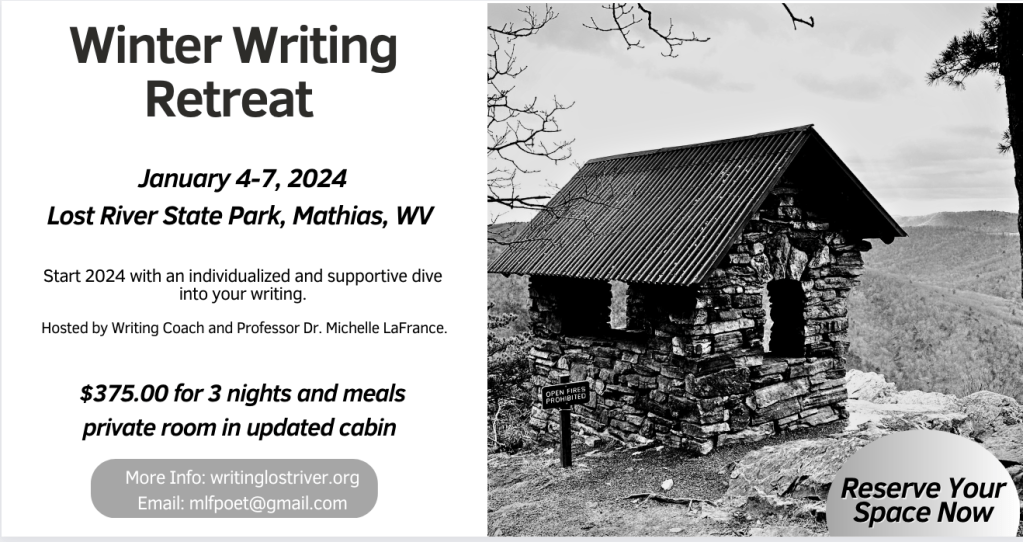
Join a small and welcoming community of writers for a personalized writing retreat in one of West Virginia’s most beautiful State Parks. Writers of all experience levels and projects are welcome—a perfect opportunity for those who have been wanting to dive into that book project, collection, essay, family history, or script. Retreat participants will be lodged in private rooms (shared kitchen and bath) in updated cabins at Lost River State Park. Facilitator is an award-winning writer, who has taught writing, coached writers, and facilitated writing communities for over 20 years.
Registration fee includes lodging and a Saturday evening public reading of your work, and all meals.
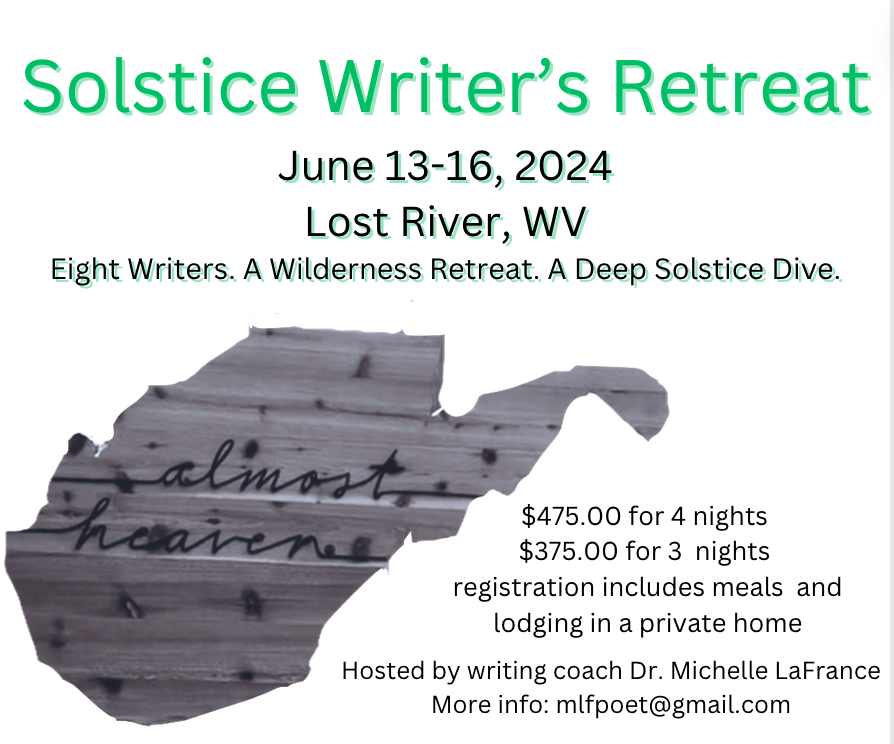
More Information on the Solstice Writing Retreat–Our Retreat Schedule Retreat time is your time. Writers may choose to focus on their writing, socialize and attend events and activities, or stay with their projects as they are called during our retreat time. Please do not feel obligated to attend any of the below events, if your work is flowing.
Wednesday, June 13th
6pm Check In (Please arrive after your own dinner) 7:30pm Tea, snacks, and introductions Private writing time through evening
Thursday, June 14th
8:00 am to 11 am: Coffee and breakfast 8 am to 6:30 pm: Private writing time Noon to 2pm: Grab and go lunch 3:00 pm: Check In (for new comers) 4:30 pm: Optional Gentle Hike 6:30 pm Dinner and Introductions 7:30 pm: Private writing time
Friday, June 15th
8:00 am: Movement with Havala (Optional) 8:00 am to 10 am: Coffee and breakfast 8 am to 6:30 pm: Private writing time Noon to 2:00 pm: Grab and go lunch 4:30 pm: Optional Gentle Hike 6:30 pm: Dinner 7:30 pm: Writers’ Group
Saturday, June 15th
8:00 am: Movement with Havala (Optional) 8:00 am to 10 am: Coffee and breakfast 8 am to 6:30 pm: Private writing time Noon to 2:00 pm: Grab and go lunch 4:30 pm: Reading in area 6:30 pm: Dinner in area 7:30 pm: Private Writing Time
Sunday, June 16th
8:00 am: Movement with Havala (Optional) 8:00 am to 10 am: Coffee and breakfast 11:00 am: Check Out
I wrote this blog post for the Hill Center’s blog. You can find the post here (along with a super-scary-BIG photo of my face. (YIKES!)
Part 1: Writing Coaches
Michelle LaFrance (our amazing writing teacher!) is guest writing on our blog about writing resources and building writing community. See more about Michelle and her Hill Center courses here.
In the classes I teach at the Hill Center, I often meet people who have only just started to write. They are excited to dig into their writing and eager to develop some version of the “writing life,” but often find themselves a little lost when it comes to knowing which resources might be the most useful. Whittling down what they find online, an admittedly overwhelming list of resources—websites, books, articles, groups, coaches, and other services—is a daunting prospect. Finding a local community of writers can be even harder. In this series of guest blog posts on writing coaches, writing groups, classes and retreats, I share several resources that will help you with your craft and in making connections with other writers in the DMV.
Writing Coaches offer new and more practiced writers an array of resources, from “write ins” to “retreats,” to personalized sessions that will help you refine your writing skills and receive feedback/guidance on your work.
Writing Coaches can be quite expensive, so be sure to ask for rates before committing to a coach. On that note: it’s a good general rule for new writers to keep in mind that writing teachers are paid professionals who will ask for payment for any services rendered, such as teaching a class, offering feedback to you, or providing direction on a draft in process. Writing is work; teaching and coaching writing is also work. DC and the greater DMV are home to a number of excellent professionals, services, and centers that can provide personalized, private, and group-oriented support. Be sure to recognize their professional stature by compensating them for their time.
Three local coaching services, I recommend:
Heart Head Hands—When students ask me about private writing coaches, I send them to Beth Godbee without hesitation. Beth takes a holistic and mindful approach to clients’ writing and interests, working as an “ideas editor” who is interested in the client’s holistic health—the source of sustainable writing practices. Beth brings years of experience as a coach, editor, teacher, researcher, and published author to her work.
Best Writers and Editors—I’ve only ever heard excellent things about this “Washington, DC-based consultancy of internationally recognized writers and editors with extensive experience in journalism and 130+ years on the job.” Best Writes and Editors provides a variety of writing, editing, and coaching services, focused on “mak[ing] your complex content clear.”
Between Two Rivers—Focused on building “writing community” via writing groups, writing retreats, and writing classes, I began organizing this group when students of my Hill Center classes asked me for follow up conversations and connections. Members of Between Rivers join a moderated Google group to co-mentor one another, share drafts, provide accountability, and enjoy the ups and downs of the writing life together. I provide coaching and support during writing retreats which take us to remote, wild locations for intensive work on a project.
You will want to let your intuitions guide you as you seek out and select a writing coach. Many coaches offer a free consultation session to discuss your needs and your projects with them before signing on.
If you cannot glean this info from an online search or dedicated website, be sure to inquire into whether the coach has published in the area of your interest. Where and how much has the coach published? Do you like the coach’s work? How about the professional “vibe” the coach gives off? What type of writers does the coach tend to work with? Does the coach have a relationship with key editors or publication venues? Are they willing to make introductions to other writers and professionals? What can you expect from the coach in a session and what will the coach expect from you in terms of production?
With a little diligent work in advance of your first session, you will be off to a fantastic and productive working relationship with your writing coach. May the community you build in support of your writing lead to a vibrant, fulfilling writing life—happy writing!
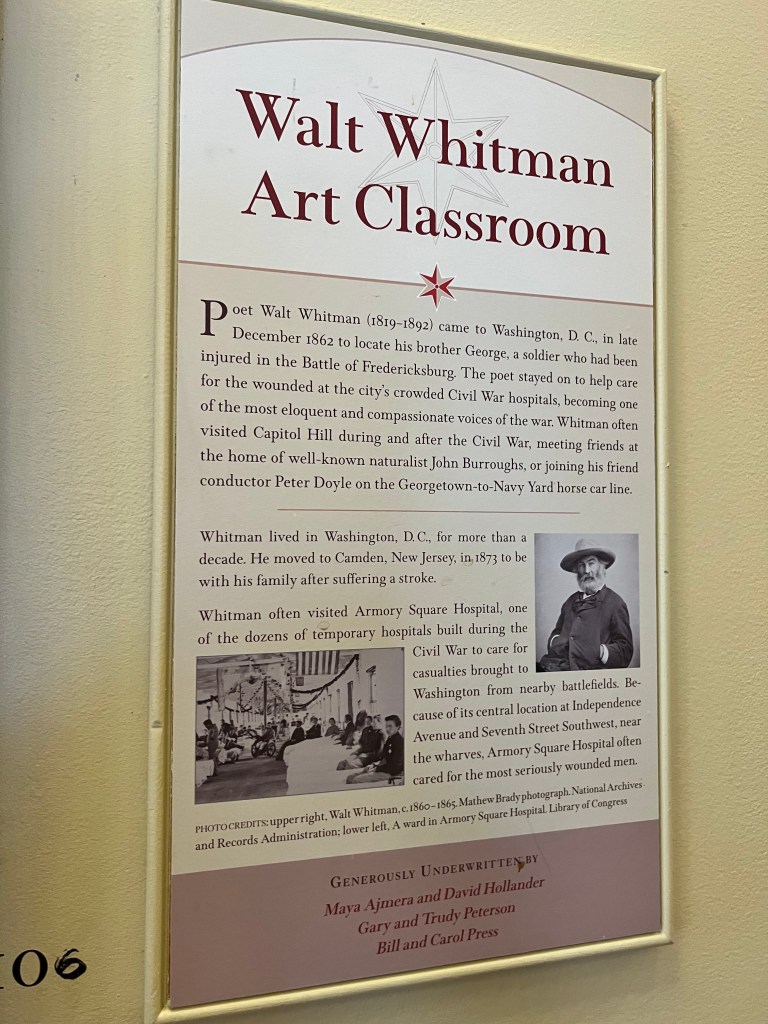
About Hill Center: Hill Center at the Old Naval Hospital offers quality programming in a restored Civil War-era hospital commissioned by President Abraham Lincoln in 1864. It is a vibrant home for culture, education and city life, and serves as a hub for community enrichment. More info: https://www.hillcenterdc.org
The good folks at the Hill Center asked me to write a blog post for them I was pleased to oblige. They were so grateful they also posted an ENORMOUS photo of my face that would terrify anyone out of their mind. Woof!
 Writing Lost River